Wednesday, March 16, 2011
Smoking in the rain: Canadian bacon
I used Canadian bacon recipe from my favorite Charcuterie book. Since I had 2 smaller pieces of pork loin, and because of the shape of the dish, I cut the brine recipe in half; I've also adjusted the quantities of the ingredients a little, to accomodate my taste for less salty meat, and unlimited garlic. To cure two 2-pound pieces of trimmed pork loin I used
2 liters water
1/2 cup kosher salt
1/3 cup brown sugar
20 gram pink salt
bunch of sage
bunch of thyme
6 large garlic cloves
The pork spent 2 days curing in the brine, covered and refrigerated.
I then took the pork out of the brine, rinsed it under cold running water, dried with paper towels, tied in a few places to keep the shape, and let it rest at room temperature while I was busy starting my primitive charcoal smoker. This took a little over an hour of blowing on the charcoals, trying to contain the sparks while not getting burned myself, moving the hot and sparkling smoker farther from the house, running to the store to get more charcoal, moving the smoker closer to the house to protect it from the beginning rain, swearing in four or five languages all the while. Finally, the little no-good termometer on the lid moved to the mark between "warm" and "ideal" and froze there. No matter what I did, it wouldn't go higher.
Not to waste all the heat, I also smoked a couple of shallots, a boiled potato, a head of garlic, and a couple of handfuls of sea salt.
At my smoker's uncertain temperature, it took the pork about 4 hours to get to the internal temperature of 145 degrees. By that time the exterior was covered by beautiful, glossy and aromatic smoked "skin".
I let the bacon cool, removed the twine, sliced it, and vacuum-packed most of it for storage.
The next day I decided that my homemade Canadian bacon deserves homemade English muffins for breakfast. The recipe I used, http://allrecipes.com//Recipe/english-muffins/Detail.aspx , calls for shortening - I replaced it with melted unsalted butter.
Also, it took only 4-1/2 cups of flour, instead of 6 in the recipe, to make workable, relatively soft dough - must be due to variations in flour and humidity.
I was very happy with my adjusted recipe, and by 3 pm I already had a perfect homemade breakfast:
Toasted English muffin, Canadian bacon, lightly poached eggs, chives from the garden, Hollandaise sauce made with 1 egg yolk, 1/2 unsalted butter, juice of 1 lemon, salt and freshly ground white pepper; Turkish coffee.
By the time I finished breakfast, it was time to think about dinner.
Slow food.
Tuesday, December 7, 2010
Winter mushroom soup
It looks like a cream soup, but the cream (creme fraiche) is actually just used for serving. The creamy body of the soup comes from root vegetables that are cooked with mushrooms in homemade chicken stock and then pureed. For a vegetarian version, replace chicken stock with vegetable broth.
The magic of this soup comes from a handful of dried porcini mushrooms. Their smell is comforting and totally irresistible, and is supported by a flavor base of winter vegetables. Make sure to add the liquid that you used to soak the mushrooms - a large part of the mushroom essence is in it.
This recipe makes four large servings of very thick soup, as is appropriate for the season. Or use more stock for a thinner version and serve it in espresso cups as an appetizer for a party.
Mushroom Soup
Serves 4
1 oz dried porcini mushrooms
1 Tbsp olive oil
1 Tbsp unsalted butter
2 leeks, sliced
2 carrots, chopped
1 parsley root, chopped
1 shallot, sliced
3 cloves garlic, sliced
8 oz white mushrooms, chopped
1/2 cup dry sherry
1 qt chicken stock
2 medium potatoes, diced
2 sprigs thyme
2 bay leaves
4 juniper berries, lightly crushed
salt, freshly ground pepper
To serve, optional: creme fraiche, minced parsley, fried shallot.
Cover dried mushrooms with hot water and soak until soft, 15-30 minutes, depending on the quality of the mushrooms. Remove mushrooms, squeeze dry, and chop, reserving the liquid. Strain liquid through a fine mesh strainer.
Meanwhile, heat olive oil and butter in a large saute pan. Add leeks, carrots, parsley root, shallot and garlic. Sweat over medium-low heat until soft but not browning, 10-15 minutes. Add porcini and white mushrooms, cook another 10 minutes. Add mushroom soaking liquid, sherry, chicken stock, thyme, bay leaves, juniper berries, and potatoes. Season with salt and pepper. Simmer gently over low heat for 20 minutes, until the potatoes are cooked.
Remove and discard thyme, bay, and juniper berries. Puree soup in blender to desired texture. I like to leave the soup a little chunky. When pureeing hot soup, work in batches, and hold the lid down firmly with a towel, to make sure that the steam doesn't force the lid off and the hot liquid all over the kitchen and the cook (been there, done this). Pour into a pan and re-heat gently.
Serve in soup bowls, garnished with creme fraiche, parsley, and/or fried shallot.
Friday, November 26, 2010
Happy Thanksgiving! Save a turkey!
We started with pork rillettes that I made in advance: I just cooked the hell out of a fatty porl shoulder, cut into cubes, seasoned with thyme, bay leaves, juniper berries, salt and pepper, covered with water. After about 6 hours of low and slow cooking, the pork was tender and easy to shred with two forks. I then strained and degreased the cooking liquid (save the fat), reduced it a little more, packed the pulled pork into small containers, spooned some of the reduce liquid over it to make jelly, chilled, and then sealed it with reserved fat. At the time of serving I scraped the fat off, and we spread the rillettes on slices of walnut bread and ate it with my homemade tarragon killer mustard. The mustard made me cry, but otherwise it was all good.
Tuesday, July 6, 2010
Celebrating the US national holiday by totally disrespecting the rim of the plate
Our friend Y. was busy sailing to see the fireworks and was not making it for dinner on 4th, so we had him over on 3rd. I got a 3-pound New York roast at half price at Safeway; after trimmimg all the extra fat and slicing it really thick, I got three serious steaks out of it. Seasoned with salt and pepper, brushed with grapeseed oil, grilled at 450 degrees to medium-rear, about 4 minutes aech side, let rest for a few minutes, and served with herb-lemon butter.
Sliced and grilled assorted summer squashes from the farmers market. The "very sweet" corn from Safeway turned out very tender, but not nearly as sweet as advertised. I pulled off the husks carefully, brushed the cobs with olive oil and sea salt, replaced the husks, and grilled over indirect heat.
For our 4th of July family grill, I marinated thick slices of pork tenderloin in red wine with sage, thyme, a lot of red onion slices, and some olive oil, for pork kabobs. It was a very hot day, and while the meat was marinating, we went to China Camp park on the Bay, to catch some breeze, and to see what other people are grilling. One of the parties was placing bacon-wrapped sausages on the grill. The light went on in my head. Double pork! This is what we should eat! And with my kabobs, it'll make it a triple!
On the way home we picked up Adelis Italian sausages and a pound of bacon. Wrapped each sausage in a strip of bacon and grilled slowly to perfection, together with the kabobs and summer squashes.
Monday, May 10, 2010
Cured braised pork shoulder
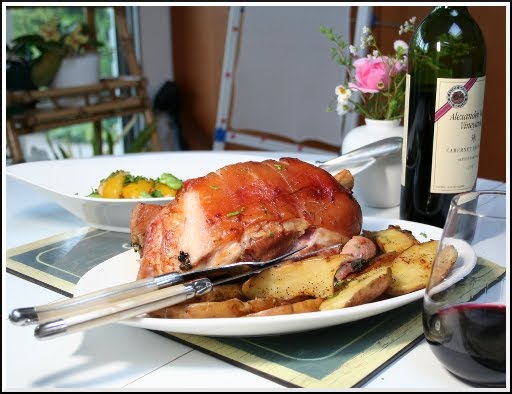
This is an unhurried preparation. It takes five days to brine the pork, then it rests to distribute the seasoning for another day, then you braise it low and slow all afternoon, and then finish it in the oven. It’s totally worth it, so melting tender, including the tasty skin, the meat is beautifully rosy pink from the brine, and so flavorful. And it actually takes very little of the cook’s time – it mostly brines and cooks itself.
On Saturday afternoon I tied up the pork, added the reserved herbs, a leek, a couple of celery stalks, 4 garlic cloves, and some 1/2 cup water, and simmered it VERY SLOWLY for about four hours. Parboiled the fingerling potatoes, got the car from the mechanic, went to the farmers market to get tomatoes and fava beans, shelled the beans, and went for a hike in the hills while it was cooking.
Took out of the oven, sliced, served with roasted potatoes and a salad of heirloom tomatoes and fava beans.
Cured braised pork shoulder
1 pork shoulder picnic, with bone and skin, about 3.5 lb
For the brine:
6 cups water
¾ cup curing mix (1 part pink salt, 4 parts sugar, 8 parts kosher salt by weight)
5 bay leaves
4 sprigs thyme
2 sprigs sage
1 Tbsp black peppercorns
5 juniper berries
Tuesday, March 9, 2010
Leftover management: piroshki
I made half of Michael's recipe for braised pork shoulder, and I liked it a lot, the melt-in-your-mouth texture, the perfectly balanced taste, the aroma of the pork roasting with the spices spreading through the house. And the price. Pork shoulder is one of the cheapest cuts of meat you can get in the supermarket.The problem is, it's a restaurant recipe, and even half of it gave me way too much of braised pork. We ate it for dinner for a couple of days, then R. got a large piece of pork, browned on all sides, with his eggs for breakfast, then I mushed it into rillettes and we ate it spread on toasts as a part of our late-night wine and cheese plate, and there was still a lot left.
Finally I mixed what was left with some rice and sauteed onions and baked it into piroshki. Piroshki can be eaten in place bread, and they go well with a soup. Or they make a very good portable snack - take them to the office for lunch, on a day sail, or put them in your backpack and hit the slopes.
My favourite piroshki dough:1 cup warm milk (body tempetature)
2-1/2 tsp dry yeast
1 tsp sugar
2-1/2 cups bread flour + more for dusting
2 Tbsp softened butter
1 egg
1/2 tsp salt
Egg wash:
1 egg
2 Tbsp water
Mix the yeast with 1/2 cup of milk and the sugar. Let sit for 20-30 minutes.
In a large glass bowl, combine 1 cup flour with the remaining milk and the milk/yeast/sugar mixture. Mix well. Cover with a clean napkin and put in a warm place until it doubles in size, for about 1 hour. Add the remaining flour, butter, egg and salt. Knead for about 5 minutes, rubbing your hand with some flour if the dough sticks to your hands.
Form the dough into a ball, put in a large glass bowl, dust with flour, cover with a napkin, and keep in a warm place until it doubles in size, 1to 1-1/2 hours.
Place the dough on a floured surface, roll out into a long log shape, and divide into 16 equal portions. Work with one portion at a time, covering the rest with a napkin to prevent drying.
Form the dough into a ball, roll out into a flat circle, place about 1 Tbsp of filling in the center and pinch the edges close. Place on a buttered cookie sheet. Repeat until you run out of the dough or filling (there is always something left over)
Prepare the egg wash: beat together the egg and water.
Brush the piroshki with the egg wash. Bake at 375 degrees until golden, about 20 minutes.
Let cool before serving.
The filling could be:
- braised or boiled beef, pork, or chicken, shredded + sauteed onions + (optional) rice or buckwheat
- steamed or boiled cabbage, spinach, kale + sauteed onions + (optional) chopped hard boiled egg
- cooked fish + rice
- sauteed mushrooms
- anything
Thursday, February 25, 2010
Pork three ways
This winter seems to last forever. Heavy storms come every other day. The market is all cabbages and root vegetables. Oh, well. Cabbages. Actually, this red cabbage I got last week was super pretty. And I had meats to go with it.So I sauteed cubes of pork loin, chunks of my home-cured bacon, and my Italian sausages with onion and garlic, added chopped cabbage, and braised the whole thing with thyme, rosemary, bay leaves, black pepper and juniper berries, in red wine.
Added a handfull of prunes halfway through cooking, as an afterthought. It turned out to be a good idea - the sweetness of the prunes balanced the salt of the meats and the wine's acidity, and Friday, January 29, 2010
Charcuterie in the middle of a storm
It's an El Nino year, the weather pattern that repeats every seven years and brings a lot of water to our otherwise dry coastal desert. The last storm went on for two weeks, with the water pouring down from the sky continuously, the roofs leaking, ponds and creeks overflowing, highways flooded, visibility zero or less, and driving a nightmare. Stay home and cook. I used the time to do more charcuterie.The salted duck breasts hang dry-curing, wrapped in cheesecloth and tied with kitchen string, in my outside laundry closet right now. The temperature in the 50-ies and the high humidity are perfect. I'll try them in one or two days.
Another storm is coming.
Wednesday, December 23, 2009
Fat, skin and guts: Italian sausage with garlic and sage
My plan of getting into the holiday mood included making Italian sausages. One of the ideas I got from this book was adding cooked pork skin to the sausage mix, to add texture and flavor. The book arrived just as I trimmed a pork shoulder picnic and a belly slab, wrapped the skins in plastic bag and prepared to toss them into garbage. Taking a short break to check out the book paid off. I unwrapped the skins, trimmed, chopped, and cooked them for about 50 minutes, rinsed, and refrigerated them alongside the seasoned meat, to grind into the sausages the next day.
The seasoning included fresh sage leaves, garlic, fennel seeds (required to make them Italian), salt, sugar, InstaCure #1 (I plan to smoke some of them, and it's a good idea to add a pinch of sodium nitrite to keep bacteria from growing in the smoker), and red wine.My meat grinder surprised me by not making any trouble this time. Nothing got stuck, nothing became an awful mushy mess. Just good clean grind. May be I am getting better at trimming and chilling the meat.
What I used:2.2 lb pork shoulder picnic, trimmed
a little over 1 lb. pork belly
skin from both, cut up, boiled for 1 hr, rinsed and chilled
1/2 bunch sage (leaves only)
5 large garlic cloves
1 tsp fennel seeds
about 3 Tbsp basic cure (1 part pink salt, 4 parts sugar, 8 parts kosher salt)
1/2 cup iced red wine
2 lengths hog casing (mine come cut in about 3-ft lengths, packed in salt; I soak and rinse them through)
This made 18 short plump sausages, just under 3 oz each. One serves as a snack, two as a regular dinner serving; when I come home from work, starved, I'd eat three.I wrap portions of two, three or four sausages in parchment paper and freeze them in labeled freezer bags. Well wrapped frozen sausages keep without losing moisture for at least two month, and they will thaw and be ready to cook after three hours in the refrigerator.
They are good sauteed, roasted, or gently grilled over indirect heat. On the side, steamed and quickly browned root vegetables and/or cabbages.Thursday, October 22, 2009
Market finds: broccolini, rapini, organic chanterelles and shitake mushrooms
The farmer's market never stops to delight and educate. Especially in Marin. Especially in fall.Last week I was all excited about broccolini, the Italian baby broccoli that tastes the way broccoli was designed by god to taste. I added it to my chanterelle mushroom pasta sauce, and found that broccolini and chanterelles complement each other perfectly.
I even made a broccolini and ham pizza topping, and the topping was delicious, but, as always, I messed up the pizza dough.This week's discovery was rapini, aka broccoli rabe. It is a relative of a turnip, and it looks like a very fat turnip flower, or a baby broccoli with yellow flowers on top. The flavor is strong, somewhat bitter, and it doesn't have the cabbage smell that broccoli has. Most recipes call for leaves and florets only, discard the stems. I found that the rapini that you get at the farmer's market (and where else would you get it? Your garden? Then you can pick the best) are tender enough to cook with the stems, just cut the dry bottom part off.
Pork medallions with rapini and shitake mushroomsserves 2
1 pork tenderloin, trimmed, cut into 1 inch thick medallions
For the brine:
1 tsp salt
1 tsp sugar
1 bay leave, torn
1 rosemary sprig
3 thyme sprigs
5 sage leaves
3 juniper berries, crushed
10 black peppercorns, crushed
3 cups water, or to cover
For the vegetables:
2 Tbsp olive oil
2 garlic cloves, minced
1 cup sliced shitake mushrooms
salt, pepper
1 bunch rapini, cut into 2 inch pieces
1/2 glass white wine
To cook the medallions:
1 Tbsp olive oil
1/2 cup white wine
1 tsp Dijon mustard
salt, pepper
Place all brine ingredients and 3 cups of water in a saucepan. Bring to a boil; stir to dissolve the salt and the sugar. Remove from heat, let cool to room temperature. Place the pork medallions in a glass or plastic bowl, cover with the brine, add more water at room temperature if needed to cover the pork completely, refrigerate overnight or up to three days.
In a large sauté pan, heat 2 Tbsp olive oil over medium heat. Add garlic, stir for about 1 minute, until it begins to brown and smell wonderful. Add the mushrooms, salt and pepper. Reduce the heat to medium-low, cook, stirring, until the mushrooms soften and release the juice. Add the rapini, stir, add the wine, reduce the heat to low. Simmer, stirring occasionally, for about 25 minutes. If the rapini start to dry out before they are fully cooked and tender, add a tablespoon of water.
Remove the pork from the brine, dry with paper towels (discard the brine).
Heat 1 Tbsp olive oil over medium heat in a sauté pan. Cook the pork medallions, turning, until golden brown on all sides, and cooked through - about 12-15 minutes. Remove from pan, keep warm.
To make the sauce, deglaze the pan with the white wine, scraping with a wooden spoon to dissolve all the brown pieces on the bottom. Reduce the sauce, whisk in the mustard and season with salt and pepper.
Serve the pork medallions over the vegetables, spoon the sauce on top.